





Trains
Background
A train is a series of connected vehicles that run along a railway track and transport people or freight. Trains are typically pulled or pushed by locomotives (often known simply as "engines"), though some are self-propelled, such as multiple units. Passengers and cargo are carried in railroad cars, also known as wagons. Most trains operate on steel tracks with steel wheels, the low friction of which makes them more efficient than other forms of transport.
Gameplay
Trains run on railway tracks. The player plans and constructs the railway system including semaphores or signals, and buys trains from the train depot. The trains can be bought with dollars or rubles. The game provides a few types of locomotives:
A train is composed of a locomotive with one or more wagons. These wagons can be divided into passenger wagons and cargo wagons. The player also buys these wagons in the train depot. This building is also the place where the player assembles the train. The player can create any train that meets their needs by dragging and dropping the wagons and locomotives. When a train runs somewhere in the world and the player would like to add, remove, sell wagons or even sell the train, the train first has to be sent back to the train depot. From the moment the train is parked in the train depot the player can change the configuration of the train or sell the train or parts of the train.
A special kind of train is the track builder. These trains are bought in the train depot and moved to their workplace, the rail construction office. From the rail construction office, they load the resources needed to build railway tracks, under the player's control, to expand the railway system.
Apart from the above-mentioned locomotives, trainsets, and wagons, trams and metros can also be bought from the train depot.
Train control buttons
Train control buttons, visible when a train is selected:
 New stop - Add a stop to the schedule.
 Copy schedule to another train.
 Delete stop - Delete the selected stop from the schedule of the train, enabled only when a stop is selected.
 Move to this stop - Force the train to drive to the selected stop from the schedule of the train, enabled only when a stop is selected.
 Launch - Available only at the rail depot to start the train moving.
 Go to depot - Force the train to drive to the selected depot.
 Change direction of train - The train comes to a halt, then starts driving again in the opposite direction.
 Sell vehicle - Sell the train immediately.
 Change color/skin - Change the color of a train, only applicable for some trains.
 Rename.
 Stop train - The train comes to a stop, and the button changes to 'Start train'.
 Start train - The train starts driving again, and the button changes to 'Stop train'.
 Ignore red signal - Force the train to ignore the red signal ahead and continue driving on the same railway track.


Train schedule buttons, visible when a train is selected:
 View line detail - Opens the line editing window.
- Set line - Opens the list of lines window.
- ?

Diesel locomotives
Read the main article for information about railway tracks, semaphores/signals and buildings related to railways.
| Vehicle | Speed | Weight | Engine | Start Date | End Date | Origin |
|---|---|---|---|---|---|---|
| 060 DA | 115 km/h | 118 t | 1250 kW | 1970 | 1976 |  Romania |
| Type-753 | 100 km/h | 73 t | 1360 kW | 1968 | 1977 | Czechoslovakia |
| CME2 | 80 km/h | 72 t | 552 kW | 1957 | 1965 | Czechoslovakia |
| CME3 | 95 km/h | 123 t | 993 kW | 1963 | 1994 | Czechoslovakia |
| DR Class-V100 | 100 km/h | 64 t | 736 kW | 1966 | 1985 | East Germany |
| DR Class-119 | 120 km/h | 99 t | 1980 kW | 1976 | 1985 | Romania |
| M62 | 100 km/h | 120 t | 1500 kW | 1965 | 2001 | Ukraine |
| SU45 | 97 km/h | 118 t | 1544 kW | 1959 | 1993 | Poland |
| 2TE-2116 | 95 km/h | 170 t | 4500 kW | 1971 | 1991 | Soviet Union |
| T3M2 | 95 km/h | 120 t | 925 kW | 1959 | 2000 | Soviet Union |
| T678 | 100 km/h | 111 t | 1470 kW | 1961 | 1967 | Czechoslovakia |
| TE7 | 100 km/h | 252 t | 2944 kW | 1956 | 1964 | Soviet Union |
| TEP70 | 100 km/h | 135 t | 2942 kW | 1973 | 2006 | Soviet Union |
| C201 | 95 km/h | 125 t | 1450 kW | 1976 | 1992 |  USA |
Electric locomotives
Read the main article for information about railway tracks, semaphores/signals and buildings related to railways.
| Vehicle | Speed | Weight | Engine | Start Date | End Date | Origin |
|---|---|---|---|---|---|---|
| Type-163 | 120 km/h | 85 t | 3480 kW | 1984 | 1992 | Czechoslovakia |
| ChS2 (25E) | 75 km/h | 120 t | 3190 kW | 1958 | 1976 | Czechoslovakia |
| ChS2r (53E) | 160 km/h | 126 t | 4200 kW | 1966 | 1972 | Czechoslovakia |
| ChS2t (63E) | 160 km/h | 126 t | 5100 kW | 1973 | 1980 | Czechoslovakia |
| ChS4 (52E) | 160 km/h | 131 t | 5100 kW | 1963 | 1972 | Czechoslovakia |
| ChS7 | 160 km/h | 172 t | 6160 kW | 1983 | 1999 | Czechoslovakia |
| DR Class-243 | 120 km/h | 82 t | 3720 kW | 1985 | Present | East Germany |
| PW-201E | 120 km/h | 115 t | 3120 kW | 1969 | 1989 | Poland |
| DR Class-E251 | 80 km/h | 124 t | 3300 kW | 1965 | 1972 | East Germany |
| VL10 | 100 km/h | 184 t | 4600 kW | 1961 | 2005 | Soviet Union |
| VL23 | 80 km/h | 137 t | 3105 kW | 1956 | 1967 | Soviet Union |
| VL80K | 110 km/h | 192 t | 6400 kW | 1961 | 1995 | Soviet Union |
Trainsets
Read the main article for information about railway tracks, semaphores/signals and buildings related to railways.
| Vehicle | Speed | Weight | Engine | Capacity | Start Date | End Date | Origin |
|---|---|---|---|---|---|---|---|
| DP (trainset) | 105 km/h | 225 t | 1200 kW | 210 
|
1949 | 1972 | Hungary |
| DR1A (trainset) | 120 km/h | 231 t | 1472 kW | 295
|
1963 | 1970 | Latvian SSR |
| PFWG EN57 | 100 km/h | 100 t | 350 kW | 325
|
1961 | 1993 | Poland |
| ER 1 (trainset) | 110 km/h | 359 t | 600 kW | 605
|
1957 | 1968 | Soviet Union |
| ER 2 (trainset) | 120 km/h | 288 t | 1200 kW | 416
|
1962 | 1984 | Soviet Union |
| DRG Class SVT 137 | 150 km/h | 182 t | 1208 kW | 130
|
1950 | 1965 | East Germany |
Motor wagons
Read the main article for information about railway tracks, semaphores/signals and buildings related to railways.
| Vehicle | Speed | Weight | Engine | Capacity | Start Date | End Date | Origin |
|---|---|---|---|---|---|---|---|
| MV-820 | 70 km/h | 32 t | 206 kW | 95
|
1959 | 1970 | Czechoslovakia |
| MV-853 | 120 km/h | 50 t | 515 kW | 115
|
1968 | 1986 | Czechoslovakia |
| M131 | 60 km/h | 16 t | 113 kW | 65
|
1948 | 1965 | Czechoslovakia |
| M152 | 80 km/h | 20 t | 155 kW | 85
|
1973 | 1982 | Czechoslovakia |
| DR Class-VT2.09 | 90 km/h | 17 t | 132 kW | 68
|
1962 | 1969 | East Germany |
Trams
Read the main article for information about railway tracks, semaphores/signals and buildings related to railways.
| Vehicle | Speed | Weight | Engine | Capacity | Start Date | End Date | Origin |
|---|---|---|---|---|---|---|---|
| 102NA | 55 km/h | 18.1 t | 166 kW | 53
|
1971 | 1982 | Poland |
| 105NA | 72 km/h | 17 t | 166 kW | 88
|
1979 | 1992 | Poland |
| 13N | 68 km/h | 18.1 t | 166 kW | 83
|
1959 | 1969 | Poland |
| CSMG | 50 km/h | 15.1 t | 182 kW | 90
|
1964 | 1978 | Hungary |
| KT8D5 | 65 km/h | 18.4 t | 180 kW | 125
|
1985 | 2003 | Czechoslovakia |
| KTM-2 | 45 km/h | 8 t | 100 kW | 90
|
1957 | 1969 | Soviet Union |
| LM68 | 65 km/h | 19 t | 180 kW | 75
|
1968 | 1975 | Soviet Union |
| LM68M | 72 km/h | 21 t | 180 kW | 150
|
1974 | 1992 | Soviet Union |
| RVR6 | 60 km/h | 20 t | 172 kW | 75
|
1959 | 1987 | Latvian SSR |
| T1 | 60 km/h | 16.6 t | 160 kW | 72
|
1952 | 1963 | Czechoslovakia |
| T2 | 65 km/h | 16.6 t | 160 kW | 82
|
1957 | 1968 | Czechoslovakia |
| T3 | 65 km/h | 16.6 t | 160 kW | 86
|
1962 | 1997 | Czechoslovakia |
| T6B5 | 65 km/h | 18.4 t | 180 kW | 95
|
1983 | 2003 | Czechoslovakia |
| Tim2 | 70 km/h | 21 t | 240 kW | 92
|
1969 | 1990 | Romania |
Metros
Read the main article for information about railway tracks, semaphores/signals and buildings related to railways.
| Vehicle | Speed | Weight | Length | Engine | Capacity | Start Date | End Date | Origin |
|---|---|---|---|---|---|---|---|---|
| Ecs | 80 km/h | 96 t | 58 m | 864 kW | 525
|
1968 | 1997 | Soviet Union |
Passenger wagons
| Vehicle | Weight | Capacity | Start Date | End Date | Origin |
|---|---|---|---|---|---|
| Ammd Wagon | 45 t | 115
|
1962 | 1989 | East Germany |
| RIC wagon | 36 t | 115
|
1963 | 1992 | East Germany |
| RT200 passenger car | 45 t | 155
|
1972 | 1989 | Soviet Union |
| TV50 | 54 t | 98
|
1953 | 1965 | Soviet Union |
| TV61 | 54 t | 110
|
1964 | 1991 | Soviet Union |
| UIC-Y wagon | 35 t | 125
|
1962 | 1997 | East Germany |
Cargo wagons
| Vehicle | Weight | Capacity | Start Date | End Date | Origin |
|---|---|---|---|---|---|
| Boxcar 11-066 | 24 t | 67 t covered | 1960 | 1972 | Soviet Union |
| Boxcar 11-270 | 22 t | 68 t covered | 1971 | 1981 | Soviet Union |
| Boxcar 11-280 | 22.5 t | 69 t covered | 1980 | 1995 | Soviet Union |
| Hopper 11-715 Cement | 18 t | 67 t 
|
1970 | 1999 | Soviet Union |
| Refrigeration - Isotherm | 24 t | 24.5 t 
|
1973 | 1999 | Soviet Union |
| Refrigeration - ZB5 | 25 t | 22.5 t
|
1960 | 1975 | Soviet Union |
| Boxcar for livestock | 17 t | 37.5 t 
|
1950 | Present | Czechoslovakia |
| Hopper car | 17 t | 60 t aggregate | 1950 | Present | Soviet Union |
| Open car 12-132 | 23 t | 69 t open | 1964 | 1998 | Soviet Union |
| Open car 12-515 | 21.5 t | 69 t open | 1972 | 1998 | Soviet Union |
| Open wagon 13-401 | 20.3 t | 67 t open Carries vehicles |
1959 | 1993 | Soviet Union |
| Open wagon 13-4012 | 18.3 t | 70 t open | 1978 | Present | Soviet Union |
| Open wagon 13-926 | 22.3 t | 79 t open Carries vehicles |
1971 | Present | Soviet Union |
| Tanker 15 1443 | 25 t | 60 t oil | 1960 | 1975 | Soviet Union |
| Tanker 15 1547 | 24 t | 68 t oil | 1973 | Present | Soviet Union |
| Tanker 15 871 | 47 t | 120 t oil | 1965 | Present | Soviet Union |
| Cement tank | 25 t | 35 t
|
1950 | Present | USA |
Track builders
All track building vehicles use diesel engines and require fuel. The laying crane UK 25 is a special case in that it cannot build bridges or electrified track. The second level value indicates how many workers the wagon can load, the other might be for storage capacity.
In expert mode: buy a disassembled track layer at a customs house. Send an open hull truck with enough capacity to carry it to the customs house, with it set to load vehicles. Then send it to the rail construction office with orders to unload vehicles.
| Vehicle | Speed | Weight | Engine | Skill | Start Date | End Date | Origin |
|---|---|---|---|---|---|---|---|
| Kzh 461 Railway crane | 50 km/h | 93 t | 775 kW | level 35 40 | 1968 | 1995 | Soviet Union |
| AGMu | 60 km/h | 29 t | 77 kW | level 10 20 | 1955 | 1985 | Soviet Union |
| DKGU-5 Crane | 50 km/h | 47 t | 170 kW | level 17 33 | 1965 | 1985 | Soviet Union |
| MUV 69 | 55 km/h | 22 t | 81 kW | level 12 25 | 1968 | 1991 | Czechoslovakia |
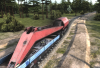 EDK-300 Railway crane |
65 km/h | 140 t | 1105 kW | level 70 | 1961 | 1995 | East Germany |
| Laying crane UK 25 | 20 km/h | 102 t | 240 kW | level 35 25 3 Can't build bridges or electrified track |
1985 | Present | Soviet Union |
References
| Vehicles | |
|---|---|
| Road vehicles | |
| Helicopters | |
| Planes | |
| Trains | |
| Ships | |


