Cards

Overview

Cards are what players interact with most frequently. They allow the player to deal damage, protect their train, and control the fight in a variety of ways.
Every card is associated with the locomotive or one of the Carriages. They represent that train unit's abilities, so the player must add that unit to the train at the start of or during the run in order to have access to any of its cards. And if a train unit is lost during a run, that carriage's cards are lost.
At a glance, players can determine the category of a card's effect by its border color:
- Blue cards apply defenses to the train.
- Red cards are offensive, damaging or impairing enemy units.
- Yellow cards affect initiative, the grid, the player's hand, Action Points, or enemy units in non-damaging ways.
At the beginning of every turn, the player draws cards from their Deck to fill their hand. At the very beginning of the game with the default train, the player's hand size is four cards. The player's hand size can be upgraded via modules. Most cards are played exactly once during a turn and then discarded. Discarded cards make their way back to the Draw pile to be drawn into the player's hand at a later turn. Many cards allow the player to draw extra cards in the middle of a fight, and this can be done regardless of the player's hand size. At the end of every player's turn, their entire hand is discarded.
Players do not need to count cards. At any time, the player can view all the cards in their Deck, the Draw Pile, the Discard Pile, etc. These views do not show the player the order in which cards will be drawn, but this information may be crucial in some situations.
-
 Draw Pile at the bottom left
-
 Deck at the top of the screen
-
 Exhaust Pile at bottom right
-
 Discard Pile right next to it


Action Points and playing cards


Cards are played by spending their Action Points (AP) listed above the card with the lightning bolt icon. For example, the card Artillery Attack requires 2  AP. At the beginning of a run, the player has 5 AP per turn. Many cards award the player extra AP, so players frequently will have more than their normal expected AP during a turn. In the screenshot, 5/5 means 5 AP left this turn (top) out of 5 AP normally expected each turn (bottom).
When not enough Action Points are left to play a card, the AP number and icon will turn red. Clicking on a card that costs too many AP will show the message Not enough AP and prevent the player from playing that card.
Clicking a card will either immediately play it or show a preview of the effect. For example, a red card with a targeting range will allow the player to target an enemy unit or grid space. Clicking again then plays the card.
Effects that change their own AP cost
- Cost Up
- This card's AP cost increases by 1 each time another card is played.
- Cost Down
- This card's AP cost decreases by 1 each time another card is played.
Many cards have the effect Cost Down or Cost Up on them. When these cards are in the player's hand, every other card played in that turn will lower or raise the AP cost of that card, respectively. Therefore, Cost Up cards are best played at the beginning of the turn, and Cost Down cards are best played once their AP cost has reached 0 . For example, Shield has the Cost Down effect, making it appropriate for a player to leave it for last after doing everything else they can to avoid taking damage.
- Charged
- This card's AP cost and power is equal to your current AP.
Cards with the Charged effect will consume all remaining AP in a turn in order to boost its power. For maximum effect, Charged cards are best played at the beginning of a turn or after other cards that increase the player's current AP.
- Inflation
- This card's AP cost increases by 1 each time this card is played.
For the duration of a fight, cards with the Inflation effect will get more expensive every time they are played. Its cost can exceed the normal AP each turn gets.
Exhaust effect
- Exhaust
- Card is sent to the exhaust pile until the end of the fight.
Cards played with the Exhaust effect are placed out of play in the Exhaust Pile until the end of the fight. Unlike other cards that go to the Discard Pile, cards in the Exhaust Pile are not recycled into the Draw Pile to be drawn again into the player's hand. These cards are generally much more powerful.
Some cards, for example Into the Furnace and Out of the Furnace take another card from the player's hand with them to the Exhaust Pile as part of their cost. Both cards will then be out of play until the next fight.
Target and impact ranges

Most cards that affect units will have limitations on which units it can affect based on where the unit is relative to the carriage in the grid.
For example, Artillery Attack can reach most grid cells that are not adjacent to the Artillery carriage. The carriage is at the center of the range pattern, where the brighter lines intersect. The horizontal brighter line represents the track, and the locomotive will be to the right of the carriage.
Other cards' ranges do not reach as far as Artillery Attack, have bigger or smaller blind spots, can reach enemies that are closer, or have entirely different patterns. For example, the cards Intent Button, Carpet Shot, and Suppressive Fire can only target enemies aligned vertically with their respective carriage, with no range to the left or right.
Some fights do not have large enough grids to see the entire targeting pattern. This can happen when the maneuverable track is short or when the carriage is too far left or right on the track (horizontally), when there is a cliff or canyon (vertically), or during smaller fights earlier in the run where the grid is smaller by default.
Impact Range

Cards that affect more than one grid cell have an Impact Range, Explosion Range, or similar grid on their card back separate from the Targeting Range.
All damage and effects happen to all cells in the impact range equally.
For example, although Carpet Shot can only shoot straight up and down from the Artillery carriage, it hits 3 cells in a line parallel to the train. Therefore, it hits any enemies that are just to the left and right of the vertical targeting line, even though it cannot directly target those grid cells.
Card modifications


Many cards have modifiable values, and all cards' AP costs can be modified. Modifiable values appear in green in the card's text.
When completing a fight with the Card modification reward bonus, the player is shown three randomly selected cards from their deck with random modifications applied to them. Modifications are diverse: Some are more powerful than others, and some are exceptionally good for certain runs or in combination with other cards in a situation.
- AP cost down
- Damage up
- Damage up and AP cost up
- Added effect, for example Exhaust or Blind
- Random AP cost
Numbers in plain gray in the card's text cannot be modified. For example, Carpet Shot is never modifiable to hit any more or less than 3 cells in a line.
Some cards can wind up having random modifiers that cancel each other out, for example a card that adds 1 AP increasing to 2 but also increasing its cost by +1 AP. Other modifications can make cards objectively worse, for example by giving a random AP cost to a card with a base cost of 0 .
-
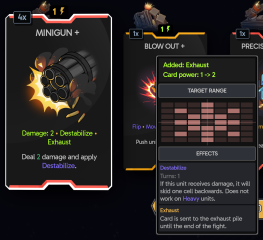 Minigun modified to add +1 Damage, but adding the Exhaust effect.
-
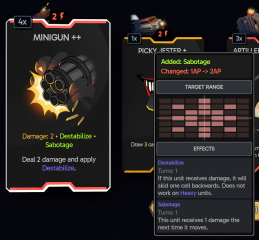 Minigun modified to add the Sabotage effect, but increasing its cost by 1.


Adding cards during a run
The run starts with a specified set of unlocked and available cards in their pool based on their chosen Locomotive and Carriages. During the run, the player may be rewarded with or purchase additional cards from this pool. When that happens, the player is given a random selection of cards from the pool to add to their deck.
- Reward for winning a fight: Choose one of three random cards.
- Upgrading a carriage: Choose one of three random cards associated with that carriage.
- Shopping at Chop Shops: Purchase any of several randomly chosen unlocked cards with
 Scrap—with the option to purchase rerolls with Scrap.
- Green dots on the map that offer Card duplication reward: Choose any one card from the deck to duplicate.
When adding cards during a run, the preview of the card includes a stack size in a box in the top left, for example x2. This is how many cards are added for the purchase price. Many cards, especially red cards, come in pairs. For example, in the screenshot of the Carpet Shot card, above, the 2x in the corner means two Carpet Shot cards will be added to the deck.
When upgrading a carriage, it is possible to acquire all the unlocked cards for that carriage. In that situation, the upgrade reward options will be Spikes bonuses or Driver Gauge bonuses instead of more cards.
Every run, the player must re-acquire cards from their pool into their deck.
-
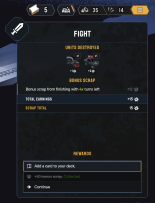 Winning a basic fight rewards a card.
-
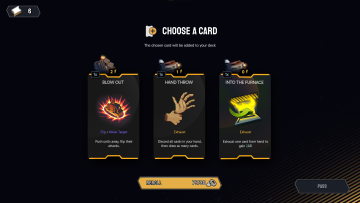 Cards added this way can belong to any train unit.
-
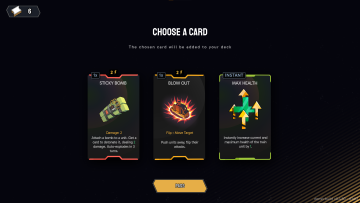 Upgrading a carriage rewards a choice of random cards from the pool (or an instant health upgrade).
-
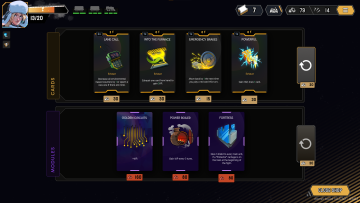 Random cards for sale at a Chop Shop.
-
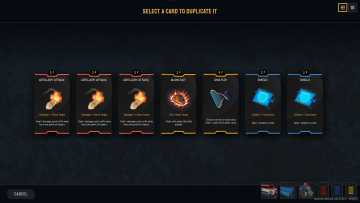 Duplicating a card as a random green-dot reward.


Progression across runs

Before starting a run, players may review their currently available modules and cards and may pay Spikes to unlock new ones. Unlocked cards are then made available to be added to the deck during the run when completing fights or purchasing cards from Chop Shops.
After ANOTHER DAY IN THE FOG, players are shown their Locomotives, Carriages, Modules & Cards, and the button to start the run. Once the run begins, the card pool is set for the remainder of the run.
The Driver's cards are not in the pool or ever in the player's deck, but become playable through the Driver Gauge mechanic.
Each locomotive and carriage has a beginning loadout of cards. A small number of cards are immediately in the deck upon starting the run. Others are initially shown with a lock icon and must be unlocked by completing runs to increase the rank of the unit. Ranking up the unit unlocks these extra cards, which are then added to the pool to find during a run.
For example, the Artillery Attack card is always in the deck when the Artillery carriage is on the train, but the Carpet Shot card must be found during the run, and the carriage has three more cards that can be unlocked by ranking up the carriage.
As another example, the Protector carriage adds two Shield cards to the deck when attached to the train. Three other cards are added to the pool to be found during the run, and three more cards can be unlocked by ranking up the carriage.
As a counter example, the Foggie locomotive's unlocks from ranking up are Modules, not cards. Compare the screenshots of the initial loadouts of these three units at the very beginning of the game, before any runs.
-
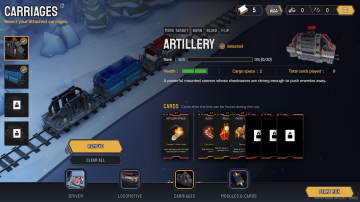 Artillery carriage deck cards, pool cards, and unlockable cards.
-
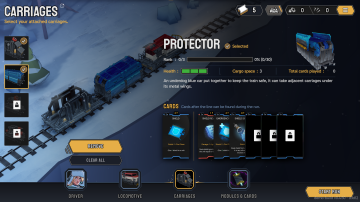 Protector carriage deck cards, pool cards, and unlockable cards.
-
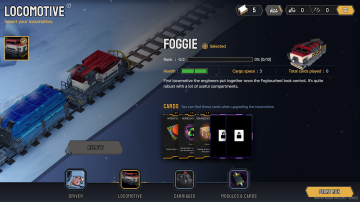 Foggie locomotive pool cards and unlockable modules.


Deactivating a Card
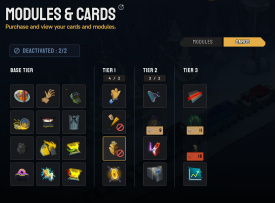
On the Modules & Cards screen, additional cards beyond the Base Tier are revealed and unlocked in tiers. Once a card has been unlocked, it is guaranteed to be in the pool. If the player changes their mind, they may Deactivate a card. The choice to deactivate a card is only available once an entire tier has been unlocked. After unlocking all four cards in a tier, the player receives two deactivation options.
Deactivating a card is beneficial when the card conflicts with the player's chosen loadout of locomotives, carriage, and other cards. It also serves to increase the likelihood of finding the other cards in the pool.
-
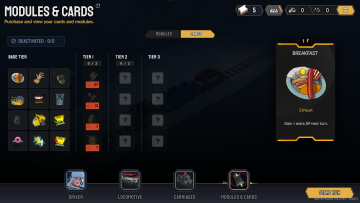 Cards available to be unlocked before a run
-
 Unlocked cards can be deactivated
-
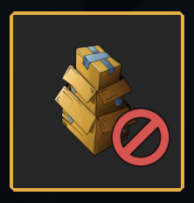 Once deactivated, the card icon in the tier list changes
-
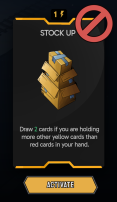 A deactivated card can be activated again with the Activate button


List of Effects
There are many effects that buff the player's units, debuff enemy units, or change the playing field. Every effect is described in-game; a tooltip will appear over the card after a short delay. For additional descriptions of the effects and interactions, find the article on the specific card.
| ! Name | Turns | Text |
|---|---|---|
| Exhaust | Card is sent to the exhaust pile until the end of the fight. | |
| Move Target | Move affected units away from the carriage. | |
| Cost Down | This card's AP cost decreases by 1 each time another card is played. | |
| Cost Up | This card's AP cost increases by 1 each time another card is played. | |
| Flip | 1 | Flip the unit's intent. |
| Blind | 1 | Blinded units cancel their intent. They move and create intents randomly while blinded. |
| Burn | 1 | Burning units take 1 damage at the end of their turn. |
| Innate | Guaranteed to be drawn first at the beginning of a fight. | |
| Destabilize | 1 | If this unit receives damage, it will skid one cell backwards. Does not work on Heavy units. |
| Ignore Shield | Action will ignore shield. | |
| Sabotage | 1 | This unit receives 1 damage the next time it moves. |
| Speared | 1 | If this unit is damaged, draw a Spearwall card from the draw or discard pile. |
| Inflation | This card's AP cost increases by 1 each time this card is played. | |
| Charged | This card's AP cost and power is equal to your current AP. | |
| Brittle | This card is destroyed when leaving the hand |
List of Cards
Base Tier Cards
| Icon | Name | AP Cost | Stack Size | Effects | Text | Scrap cost |
|---|---|---|---|---|---|---|
 |
Breakfast | 1 | 1 | Exhaust | Gain 3 extra AP next turn. | 81–123 |
 |
Hand Throw | 1 | 1 | Exhaust | Discard all cards in your hand, then draw as many cards. | 73–123 |
 |
Waste Not | 0 | 1 | None | Discard the rightmost card in your hand, gain 1AP, draw 1 card. | 71–91 |
 |
Emergency Brakes | 0 | 1 | None | Move back by 1 the next time you play a red card this turn. | 68–126 |
 |
Picky Jester | 1 | 1 | None | Draw 2 cards, discard 1 card. | 93–99 |
 |
Pre-empt | 0 | 1 | Exhaust | Gain 2AP. Start next round with 2AP less. | 121–174 |
 |
Emergency Coal | 0 | 1 | None | Move forward by 1 the next time you play a red card this turn. | 66–91 |
 |
Hot Cask | 4 | 1 | Cost Down | Draw 2 cards. | 64–98 |
 |
Into the Furnace | 0 | 1 | Exhaust | Exhaust one card from hand to gain 2AP. | 101–198 |
 |
Mastermind | 1 | 1 | None | Pick 1 card from the draw pile to move to the top of the pile. | 177–229 |
 |
Lane Call | 2 | 1 | Exhaust | Decrease all environmental hazard counters by 1 or spawn a new one if there are none. | 102–154 |
 |
Out of the Furnace | 0 | 1 | Exhaust | Exhaust one card from hand, add AP equal to the exhausted card's AP cost. | 164–261 |