





U377: Difference between revisions
Retarget redlink to the existing Vehicle production page |
Standardise tables on wikitable: the va-table and legacy Fandom classes depend on theme variables this wiki does not define, so these tables rendered without borders or padding |
||
| (One intermediate revision by the same user not shown) | |||
| Line 11: | Line 11: | ||
==Variants== | ==Variants== | ||
{| class=" | {| class="wikitable sortable" style="text-align: center; width: 100%" | ||
! data-sort-type="text" | Vehicle | ! data-sort-type="text" | Vehicle | ||
! data-sort-type="number" | {{tooltip|Speed|Maximum vehicle's speed}} | ! data-sort-type="number" | {{tooltip|Speed|Maximum vehicle's speed}} | ||
| Line 70: | Line 70: | ||
===Acquisition=== | ===Acquisition=== | ||
They are produced in the [[Soviet Union]] and are purchased using [[rubles]]. They can also be produced at a [[Vehicle production|vehicle production line]] facility. | They are produced in the [[Soviet Union]] and are purchased using [[rubles]]. They can also be produced at a [[Vehicle production|vehicle production line]] facility. | ||
{| class=" | {| class="wikitable sortable" style="text-align: center; width: 100%" | ||
! data-sort-type="text" | Vehicle | ! data-sort-type="text" | Vehicle | ||
! data-sort-type="number" style="width: 10%;" | Period | ! data-sort-type="number" style="width: 10%;" | Period | ||
| Line 158: | Line 158: | ||
* The U377 is modeled after Ural 377, a civilian model of [https://en.wikipedia.org/wiki/Ural-375 Ural-375], which served Soviet military needs from 1979 until being replaced by [https://en.wikipedia.org/wiki/Ural-4320 Ural-4320]. These trucks were produced by Ural Automotive Plant located in Miass, Chelyabinsk Oblast. | * The U377 is modeled after Ural 377, a civilian model of [https://en.wikipedia.org/wiki/Ural-375 Ural-375], which served Soviet military needs from 1979 until being replaced by [https://en.wikipedia.org/wiki/Ural-4320 Ural-4320]. These trucks were produced by Ural Automotive Plant located in Miass, Chelyabinsk Oblast. | ||
* The U377 crane variant cannot transport cargo of any sort; it is instead used as a construction site mechanism. | * The U377 crane variant cannot transport cargo of any sort; it is instead used as a construction site mechanism. | ||
* The U377 logger is the most productive and cost-effective mechanism that can be used at a woodcutting post. | * The U377 logger is the most productive and cost-effective mechanism that can be used at a [[Woodcutting Post|woodcutting post]]. | ||
* The U377 logger is the fastest variation of these vehicles, having a speed of 65 km/h instead of 60 km/h. Its speed was likely boosted due to its work type. | * The U377 logger is the fastest variation of these vehicles, having a speed of 65 km/h instead of 60 km/h. Its speed was likely boosted due to its work type. | ||
Latest revision as of 17:53, 8 August 2026

|
Deletion required (reason: All information has been consolidated on the road vehicles and vehicle families pages)
This article has been named to be deleted as outlined below.
|
|---|

|
Content review required
This article has been deemed to require a review of it's content.
|
|---|
|
|
Image needed (description: none given)
This article is missing an image. You can help us by uploading it.
|
|---|
The U377 is a truck type in Workers & Resources: Soviet Republic.
Characteristics
The U377 is a general-purpose, 7 t, six-wheeled truck model produced by the Soviet Union. It is used in multiple roles, as it is a reliable vehicle. Its overall low speed and low cargo capacity are big setbacks for these vehicles, being usually quite low even compared to other vehicles available in the 1960s. Coincidentally, their low velocity has no real impact on work on dirt and gravel roads, as their maximum speed is 60 km/h, the maximum speed on gravel roads, indicating that the vehicle may have been designed with rural applications in mind.
Its military-looking shape and drab green colours may not be a coincidence, as the USSR was known to adapt some of its military models for the civilian market. This makes the U377 possibly a civilian version of a military truck, like its real-life counterpart.
Variants
| Vehicle | Speed | Weight | Power | Use | Production |
|---|---|---|---|---|---|
 U377 cistern |
60 km/h | 7t | 132 KW | Oil tanker - 7.5t (    ) )
|
1965-1983 |
 U377 covered |
60 km/h | 7t | 132 KW | Covered hull (6.0t  , 5.3t , 5.3t , 3.8t , 3.8t , 3.8t , 3.8t , ,3.8t  , 3.8t , 3.8t , 2.8t , 2.8t , 2.6t , 2.6t , ,2.6t  , 2.3t , 2.3t , 1.9t , 1.9t ) )
|
1965-1983 |
 U377 crane |
60 km/h | 7t | 132 KW | Road crane (speed/level 26) | 1965-1983 |
 U377 dumper |
60 km/h | 7t | 132 KW | Dumper - 7t (           ) )
|
1965-1983 |
 U377 logger |
65 km/h | 7t | 132 KW | Feller tree capacity (speed/level 20) (14t  , 14t , 14t ) )
|
1965-1983 |
 U377 open hull |
60 km/h | 7t | 132 KW | Open hull (7.5t  , 7.5t , 7.5t , 7.5t, 7.5t, , 7.5t, 7.5t,6.8t  , 6.0t , 6.0t , 4.5t ) , 4.5t )Can load vehicles on flatbed - 7.5t |
1965-1983 |
Acquisition
They are produced in the Soviet Union and are purchased using rubles. They can also be produced at a vehicle production line facility.
| Vehicle | Period | 
|

|

|
|
|
|
|
|
|---|---|---|---|---|---|---|---|---|---|
| U377 cistern | 1965-1983 | 
|

|
514 | 7.3t | 0.31t | 0.005t | 1.1t | 0.14t |
| U377 covered | 1965-1983 |
|
|
514 | 7.3t | 0.31t | 0.005t | 1.1t | 0.14t |
| U377 crane | 1965-1983 |
|
|
514 | 7.3t | 0.31t | 0.005t | 1.1t | 0.14t |
| U377 dumper | 1965-1983 |
|
|
514 | 7.3t | 0.31t | 0.005t | 1.1t | 0.14t |
| U377 logger | 1965-1983 |
|
|
514 | 7.3t | 0.31t | 0.005t | 1.1t | 0.14t |
| U377 open hull | 1965-1983 |
|
|
514 | 7.3t | 0.31t | 0.005t | 1.1t | 0.14t |
Notes
- The U377 is modeled after Ural 377, a civilian model of Ural-375, which served Soviet military needs from 1979 until being replaced by Ural-4320. These trucks were produced by Ural Automotive Plant located in Miass, Chelyabinsk Oblast.
- The U377 crane variant cannot transport cargo of any sort; it is instead used as a construction site mechanism.
- The U377 logger is the most productive and cost-effective mechanism that can be used at a woodcutting post.
- The U377 logger is the fastest variation of these vehicles, having a speed of 65 km/h instead of 60 km/h. Its speed was likely boosted due to its work type.
Bugs
- The U377 logger was capable of working as an open-hull vehicle, being able to carry bricks, prefab panels and steel. This feature was removed with update X[verification required ]
Gallery
-
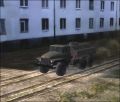 U377 cistern variant
 -
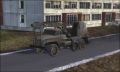 U377 crane variant
 -
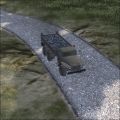 U377 dumper variant, loaded with quarried stone
 -
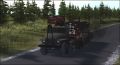 U377 logger variant, loaded with wood
 -
 U377 open hull variant, loaded with prefab panels
 -
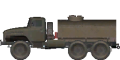 U377 cistern side preview
 -
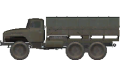 U377 covered side preview
 -
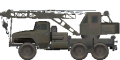 U377 crane side preview
 -
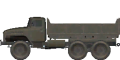 U377 dumper side preview
 -
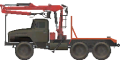 U377 logger side preview
 -
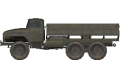 U377 open hull side preview


