Custom Game Colony Setting: Difference between revisions
mNo edit summary |
mNo edit summary |
||
| Line 13: | Line 13: | ||
*[[Termite]] colonies have nineteen-tiled queen chambers and must start with some lignocellulose storage tiles and some fungus storage tiles. | *[[Termite]] colonies have nineteen-tiled queen chambers and must start with some lignocellulose storage tiles and some fungus storage tiles. | ||
You can control temperament of non-player colonies: ''Docile'', ''Timid'', ''Balanced'' and ''Aggressive''. It affects their aggressiveness and unit composition. | You can control temperament of non-player colonies: ''Docile'', ''Timid'', ''Balanced'', ''Hostile'' and ''Aggressive''. It affects their aggressiveness and unit composition. | ||
You can also control how quickly non-player colonies make decision. | You can also control how quickly non-player colonies make decision. | ||
| Line 77: | Line 77: | ||
File:Genethief Docile.png|Docile | File:Genethief Docile.png|Docile | ||
File:Genethief Timid.png|Timid | File:Genethief Timid.png|Timid | ||
File:Genethief Balanced.png|Balanced | File:Genethief Balanced.png|Balanced | ||
</gallery> | </gallery> | ||
| Line 85: | Line 85: | ||
File:Fire Docile.png|Docile | File:Fire Docile.png|Docile | ||
File:Fire Timid.png|Timid | File:Fire Timid.png|Timid | ||
File:Fire Balanced.png|Balanced | File:Fire Balanced.png|Balanced | ||
</gallery> | </gallery> | ||
| Line 93: | Line 93: | ||
File:Wood Docile.png|Docile | File:Wood Docile.png|Docile | ||
File:Wood Timid.png|Timid | File:Wood Timid.png|Timid | ||
File:Wood Balanced.png|Balanced | File:Wood Balanced.png|Balanced | ||
</gallery> | </gallery> | ||
| Line 103: | Line 103: | ||
File:Bigheaded Docile.png|Docile | File:Bigheaded Docile.png|Docile | ||
File:Bigheaded Timid.png|Timid | File:Bigheaded Timid.png|Timid | ||
File:Bigheaded Balanced.png|Balanced | File:Bigheaded Balanced.png|Balanced | ||
</gallery> | </gallery> | ||
| Line 113: | Line 113: | ||
File:Matabele Docile.png|Docile | File:Matabele Docile.png|Docile | ||
File:Matabele Timid.png|Timid | File:Matabele Timid.png|Timid | ||
File:Matabele Balanced.png|Balanced | File:Matabele Balanced.png|Balanced | ||
</gallery> | </gallery> | ||
| Line 121: | Line 121: | ||
File:Leafcutter Docile.png|Docile | File:Leafcutter Docile.png|Docile | ||
File:Leafcutter Timid.png|Timid | File:Leafcutter Timid.png|Timid | ||
File:Leafcutter Balanced.png|Balanced | File:Leafcutter Balanced.png|Balanced | ||
</gallery> | </gallery> | ||
| Line 129: | Line 129: | ||
File:Termite Docile.png|Docile | File:Termite Docile.png|Docile | ||
File:Termite Timid.png|Timid | File:Termite Timid.png|Timid | ||
File:Termite Balanced.png|Balanced | File:Termite Balanced.png|Balanced | ||
</gallery> | </gallery> | ||
Revision as of 23:16, 15 March 2025
This page shows the colony settings in custom games.
Settings
You can play with or without other colonies in custom games. You must choose a color and a team for each colony before you start a custom game. You can only have up to 4 colonies and 4 teams in a custom game.
Some colonies may have different headstart from story missions and extra missions.
- Leafcutter ant colonies have nineteen-tiled queen chambers and start with 200 food.
- Matabele ant colonies must start with some soldier brood tiles.
- Termite colonies have nineteen-tiled queen chambers and must start with some lignocellulose storage tiles and some fungus storage tiles.
You can control temperament of non-player colonies: Docile, Timid, Balanced, Hostile and Aggressive. It affects their aggressiveness and unit composition.
You can also control how quickly non-player colonies make decision.
You can also control their cheat setting. Non-player colonies can have headstart, spend less resources to build tiles, receive food over time, spawn units without requiring food or workers and take less damage from swarm enemies. Cheat is disabled when nest invasion is happening.
- None: Small starting nest, small starting food amount, extremely rare free spawning
- Headstart: Small starting nest, small starting food amount, rare free spawning
- Underhanded: Small starting nest, medium starting food amount, slightly reduced building cost, rare free spawning
- Cheater: Medium starting nest, large starting food amount, moderately reduced building cost, occasional free spawning and food receipt
- Crooked: Large starting nest, large starting food amount, greatly reduced building cost, occasional free spawning and food receipt
- Corrupt: Large starting nest, large starting food amount, greatly reduced building cost, frequent free spawning and food receipt
Non-player colonies aren't affected by upkeep and randomized caverns. You can control whether colonies can enter other nests.
Behaviors
Non-player colonies will send all units outside to gather food. Nanitic workers will stay inside after you have played for 10 minutes and are only deployed when non-player colonies don't have any other units.
Non-player colonies can only control up to 3 pheromone groups. They can be assigned with gathering food, taking aphids or attacking enemy colonies.
Gathering groups attack any enemies on the way when they are gathering food. Food gathering and attacking is disabled when they are taking aphids.
Gathering groups are kept inside if they can't find any food.
Non-player colonies will choose the weakest colonies in biomass as their targets after they have enough food. Attacking groups either follow their most recently placed pheromone markers or invade their nests. Food and aphid gathering is disabled in the process.
Attacking groups will be tasked with gathering food and retreat after they have taken enough casualties.
Attack frequency is affected by temperament setting.
Non-player colonies will retreat inside when nest invasion occurs or when water level is about to change.
Non-player colonies can actively hunt uber creatures when the victory condition requires.
Nest designs
Non-player colonies always start with the same predug nest and some resources. They usually work on 2 chambers at once. They prioritize upgrading storage and soldiers first and only upgrade workers after other building jobs have been finished.
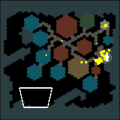
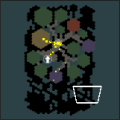
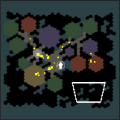
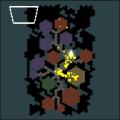
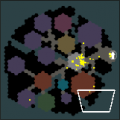
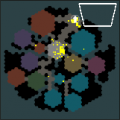
Playable units are categorized into 3 groups based on tile color on the minimaps: worker (green), small soldier (purple or orange) and large soldier (blue).
Non-player colonies can decide building order on their own. They can only build hexagon chambers and can't build highway. Nest design and unit composition are affected by species choice and temperament setting.
Gene-thief ant/ Custom
Non-player colonies will randomly choose among the available units in the same group and attempt to build a chamber for each unit. Large soldiers are replaced with small soldiers if they aren't available. Small soldiers are replaced with workers if they aren't available.
Non-player colonies treat Matabele ant soldiers as large soldiers and can't use bullet ant soldiers.
Custom leafcutter ant colonies use the base leafcutter ant nest designs. Small soldiers replace leafcutter ant mediae while large soldiers replace leacutter ant majors.
Custom termite colonies use the base termite nest designs. Small soldiers replace termite minor soldiers while large soldiers replace termite major soldiers.
Other custom colonies have to use the base gene-thief ant nest designs.
-
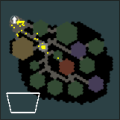 Docile
-
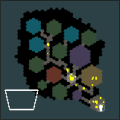 Timid
-
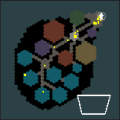 Balanced


Black ant/ Fire ant/ Little black ant
-
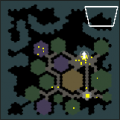 Docile
-
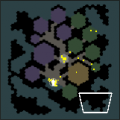 Timid
-
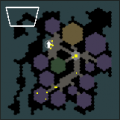 Balanced


Wood ant
-
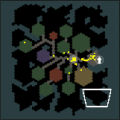 Docile
-
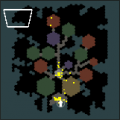 Timid
-
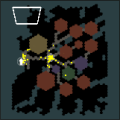 Balanced


Big-headed ant
Big-headed ant colonies have to finish building major brood chambers before starting supersoldier brood chambers.
-
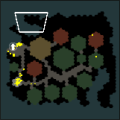 Docile
-
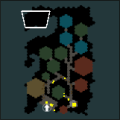 Timid
-
 Balanced


Matabele ant
Matabele ant colonies alternate between building medic brood chambers and soldier brood chambers.
-
 Docile
-
 Timid
-
 Balanced


Leafcutter ant
-
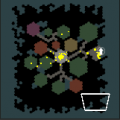 Docile
-
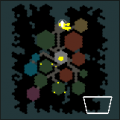 Timid
-
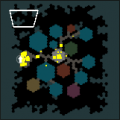 Balanced


Termite
-
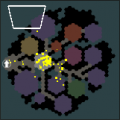 Docile
-
 Timid
-
 Balanced


Trivia
(none)